

In the wake of the thrashing dealt the Liberal Party at the 3 May federal election, its advertising agency, otherwise known as News Crap Australia, has been trying to determine what went wrong and why voters did not follow its repeated decrees to elect Peter Dutton as the nation’s prime minister at the head of a far-right Trump-style government.
Michelle Gunn, editor-in-chief of the Murdoch media’s national broadshit The Australian (far right at left in main picture) is one News Crap functionary trying to make sense of the result.
The Bug has obtained exclusive access to a recording of a phone call she placed to one of the newspaper’s regular columnists, Henry Ergas, (far right at right in main picture) seeking his views. We publish a transcript of the call below.


Henry Ergas: Hello?
Michelle Gunn: Henry! Michelle Gunn here. Sorry to disturb you. I know you’ll be busy like the rest of the nation wondering how the voters got it so very, very wrong. But I just wanted to pick your brain about why that happened and, more importantly, why voters aren’t listening to us here at News Crap any more.
HE: Well Michelle I’ve already addressed that in a column published in The Oz on Friday. (below)
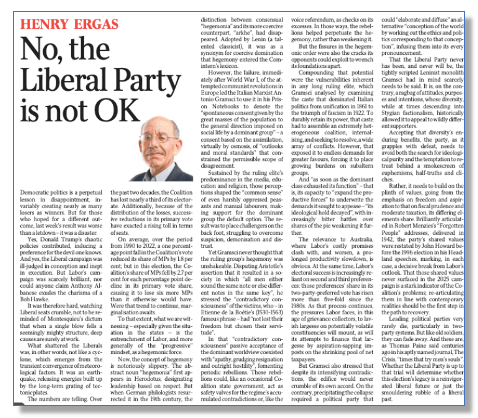
MG: Indeed, Chris Uhlmann told me you wrote a very snappy and informative column explaining why the Liberal Party lost the election.
HE: Oh, that was nice of him.
MG: Not just him either. Greg Sheridan said he found it fascinating and very much to the point.
HE: Well, well. He’s too kind.
MG: I’m sorry I haven’t had a chance to read it myself, but what with the election wash-up and all I just haven’t had time.
HE: Don’t worry about it. Perhaps it’s best if I read verbatim to you some key points I made in my column.
MG: Oh good. That sounds exactly what I’m after. Go for it, Henry.
HE: What we are witnessing …. is the entrenchment of Labor, and more generally of the “progressive” mindset, as a hegemonic force. Now, the concept of hegemony is notoriously slippery. The abstract noun “hegemonia” first appears in Herodotus, designating leadership based on respect. But when German philologists resurrected it in the 19th century, the distinction between consensual “hegemonia” and its more coercive counterpart, “arkhe”, had disappeared.
MG: Okay.
HE: Adopted by Lenin (a talented classicist), it was as a synonym for coercive domination that hegemony entered the Comintern’s lexicon. However, the failure, immediately after World War I, of the attempted communist revolutions in Europe led the Italian Marxist Antonio Gramsci to use it in his Prison Notebooks to denote the “spontaneous consent given by the great masses of the population to the general direction imposed on social life by a dominant group” – a consent based on the assimilation, virtually by osmosis, of “outlooks and moral standards” that constrained the permissible scope of disagreement.
MG: Yes, yes.
HE: Sustained by the ruling elite’s predominance in the media, education and religion, those perceptions shaped the “common sense” of even harshly oppressed peasants and manual labourers, making support for the dominant group the default option. The result was to place challengers on the back foot, struggling to overcome suspicion, demonisation and distrust.
MG: Uh uh.
HE: Yet Gramsci never thought that the ruling group’s hegemony was unshakeable. Disputing Aristotle’s assertion that it resulted in a society in which “all men either sound the same note or else different notes in the same key”, he stressed the “contradictory consciousness” of the victims, who – in Etienne de la Boétie’s (1530-1563) famous phrase – had “not lost their freedom but chosen their servitude”.
MG: Okay. Got it.
HE: But Gramsci also stressed that despite its intensifying contradictions, the edifice would never crumble of its own accord. On the contrary, precipitating the collapse required a political party that could “elaborate and diffuse” an alternative “conception of the world by working out the ethics and politics corresponding to that conception”, infusing them into …
MG: (interrupting) Look, thanks Henry. I think I’ve heard enough. Thanks for writing that and for reading it to me. I really appreciate your efforts. But even having heard all that I still can’t fathom why voters aren’t listening to us.
HE: I know. It’s a mystery, isn’t it?
MG: Sure is.

Want to be alerted immediately a new blog hits Australia’s longest running and most offensive satire site? Simply click on the Follow sign or the link below to be emailed new yarns the moment they are uploaded! The very second we go far too far – and trust us we will – you can then quickly unfollow via the three dots!
Follow The Bug Online on WordPress.com

 The Bug Online