
Australia’s most respected political mind and The Bug’s occasional political commentator RUFUS BADINAGE recalls the time he was deeply involved in an Optus-style data breach.

The recent kerfuffle over the massive data breach experienced by Optus brought back memories of a similar incident more than 50 years ago which I personally helped to expose.
It was early 1972 and at the time I was based in the office of the then Prime Minister Sir William McMahon in Canberra as his special adviser on new technology.
In 1971 Sir William had taken over as Liberal Party leader and therefore PM from the colourful John Gorton.
Sir William then set about drafting his plans for the re-election of the Liberal and Country Party coalition government at the next election due in late 1972.
He was up against a very smart Opposition Leader in Gough Whitlam who, as we know now, defeated Sir William at the December 1972 election.
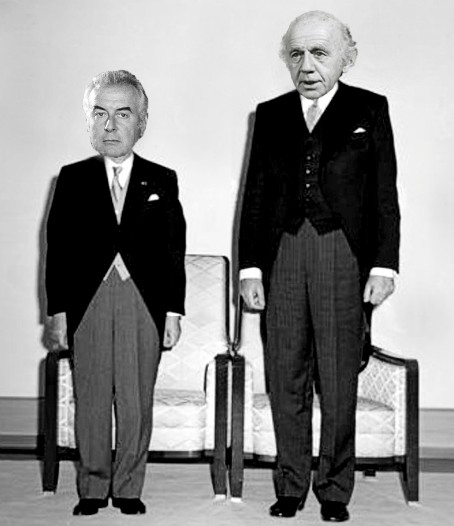
Popular history views Sir William as a rather smallish man with a rather smallish view of the world compared with the rather tall and visionary Mr Whitlam, but the truth was the exact opposite. (pictured)
Mr Whitlam was certainly ahead in the opinion polls and Sir William made it known in Canberra circles that he was on the lookout for someone to help develop a visionary new policy for his government that he felt might just give him a fighting chance come December.
I did not know until later who had recommended me to Sir William, but I was very surprised to receive the offer of a job in the PM’s office, on secondment of course.
I was working away one afternoon at my desk in the Bureau of Tick Eradication, the Arts, and Native Affairs, where I was Second Assistant Deputy Under-Secretary when the phone rang.
It gave me a start because it had not rung for some considerable time. Many weeks in fact.
It was the PM himself who asked me to head to his office, which I did, and where he explained the role he wanted me to play.
“Rufus, I have heard tremendous things about you,” Sir William began. “I think you’re the one who can help me develop a new policy that will …… be the envy of the world.”
I could tell that the PM had wanted to say I would help him be re-elected but I knew that he knew that I had always been scrupulously bipartisan in my career and had worked for all sides of politics.
Sir William then started to outline the type of policy he wanted to take to the election.
“I want a cutting-edge, high-tech policy. Something that is visionary but achievable, and one that will lead us into the 21st century which is just over 25 years away,” he began.
He then spent the best part of an hour outlining in detail the type of developments occurring around the world that he wanted repeated here in Australia.
“Did you know, Rufus, that right now there exists a machine that can scan and send documents over the phone? Around the world if you want to send them that far,” he said. “I know because I am having a room cleared out in this very office to accommodate one.
“Also right now overseas they are working on a so-called ‘teletext’ system that allows text to be sent over TV signal spectrums to be read on TV screens.”
He went on to tell about a system being used in the UK that enabled people connected to individual computer networks in a government department or big business to send each other messages. Electronic mail or “e-mail” it was dubbed, apparently.
“Those very same individual computer networks are also the subject of research into how they might be linked to each, a sort of internetworking or internetting,” he told me very excitedly.
“Communications is undergoing a revolution Rufus, and I want Australia to get in on the ground floor on all this and I want you to help me. I want you to work on this exclusively for the next month.”
That’s exactly what I did. I spent long days researching the latest trends in “information technology” or “IT” as it was starting to become known.
After a month I delivered my report directly to Sir William and he began to read it with great anticipation.
In the end I had made only one recommendation – that the bicycles used by staff of the then Postmaster General’s Department (PMG) to deliver telegrams should be retrofitted with stands so that they did not need to lean the bikes against walls, or worse, lie them flat on the ground. This, I deduced, would save valuable time per delivery and speed up communications immensely.
All the PM said after consuming my report was: “So it’s true?”
I was puzzled by the remark and asked for an explanation. Sir William then told me he had discovered that somebody on Mr Whitlam’s staff had recommended me for the job.
I felt very proud that my skills had such bipartisan support but Sir William did not seem to share that view.
Yet he was clearly overcome by the enormity of my work. All he could say was “You can’t…” before trailing off and throwing my report on his desk.
After a moment of silence he told me he had never read anything like it, which again made me feel very proud.
After another silence Sir William explained that because he could not easily terminate my secondment he would be giving me a new task to fill in the remainder of my six-month stint in his office.
He was personally directing me to count the PMG’s public telephone boxes in the nation, starting with Canberra.
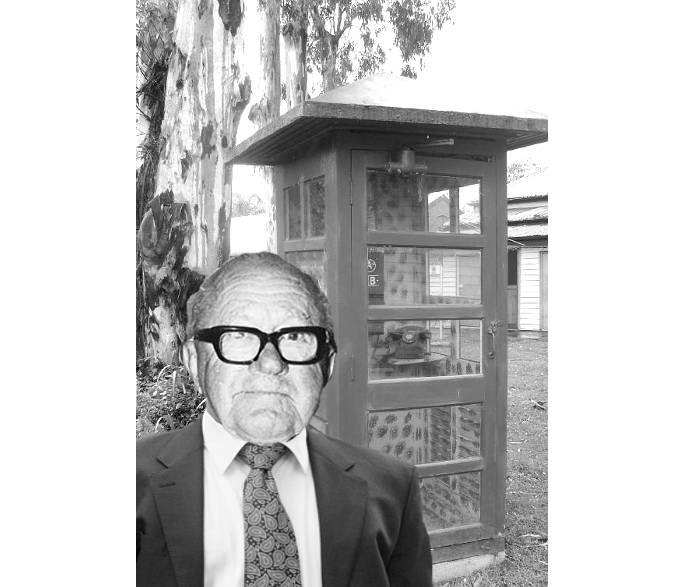
This new task I embraced with just as much enthusiasm as my previous assignment. (main picture)
But little was I to know that it would lead me to uncover a scandal similar to the one that is now consuming the Optus phone company.
It was on my very first day tramping the streets of our national capital with a clipboard and street directory in hand that I discovered a phone box close to what is now Old Parliament House was missing its White Pages A-Z directory.
I soon realised the enormity of the situation.
This was a huge data breach. Each phone book contained the surname, initials, address, and phone number of everyone in the ACT who could afford to have a phone installed.
I believed that this vital and sensitive personal data could be used for nefarious purposes if it fell into the wrong hands.
In less than an hour I discovered other nearby phone boxes that had similarly had their phone books stolen.
I decided to act promptly and went directly to Parliament House and to the Prime Minister’s Office where I demanded to see Sir William.
The message came back to his receptionist that the PM was very busy and I would need to come back at a later time.
When I asked what time I should return the young lass at the reception desk advised: “He says 2022.”
I was then escorted out of the building by security staff and left to cool my heels until returning slightly early at 8.20pm only to find the building closed.
Subsequent efforts to contact the PM were fruitless but I did write to him and explain my discovery and concerns but never heard from him again.
Rufus Badinage MBE, now retired, is one of Australia’s leading experts on politics and public administration having worked as a senior bureaucrat for various state and federal governments.
 The Bug Online