
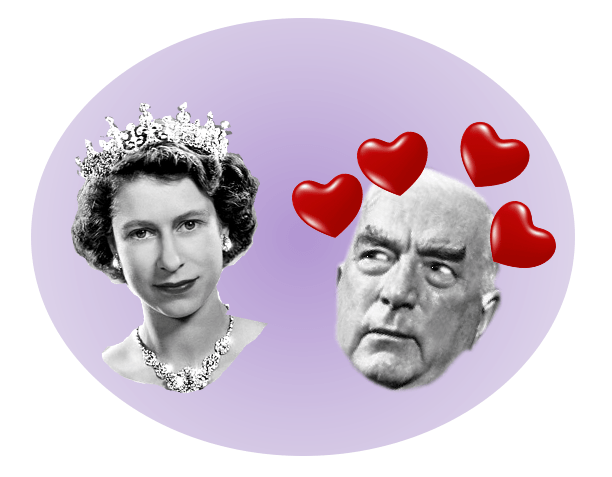
Following the death of Her Majesty Queen Elizabeth II one of Australia’s most respected political minds and The Bug’s occasional political commentator RUFUS BADINAGE recalls the time he saved Prime Minister Sir Robert Menzies from an embarrassing faux pas at a royal dinner.

Regular readers of The Bug will know that I have written on these pages previously about an incident that almost derailed our late Monarch’s royal tour of Australia in 1963.
It occurred, or should I say almost occurred, at an official state reception hosted by then Prime Minister Sir Robert Menzies and held in Parliament House in honour of Her Majesty and the Duke of Edinburgh who was travelling with her.
At the time I was attached to Sir Robert’s office as a special adviser, being on secondment from my permanent post as Senior Under-Secretary for Tick Eradication Subsidies in the Department of Agriculture and Native Affairs.
The events of that night came flooding back to me on hearing the sad news of Her Majesty’s passing just a few days ago.
The royal tour of 1963 dominated the news across Australia and every move the Queen made was carefully reported as were all of her important landmark speeches, although I cannot recall right now the deep and insightful messages they contained. But I am sure they were message for the ages.
Before the dinner in King’s Hall at the old Parliament House the Prime Minister spoke to me and asked what he should say in his speech that night.
I suggested that he recite a stanza or two of poetry to express his feelings for the Queen.
I thought no more of it until he told me he had chosen some verses from There Is a Lady Sweet and Kind by 17th Century British poet Thomas Ford.
That information was delivered to me by Sir Robert just moments before he took to the stage to deliver his speech in the Queen’s honour.
He rose from his place at the royal table adjacent to mine and, as he walked to the lectern, stopped briefly to bend down and whisper in my ear: “It’s all up here Rufus.”
Pointing at his head he added: “I’ve memorised every line.”
From my seat I could clearly see the Queen’s face and the Duke of Edinburgh’s as the PM recited the first verse.
There is a lady sweet and kind,
Was never face so pleased my mind;
I did but see her passing by
And yet I love her till I die.
I notice the Queen blush and the Prince Philip look uneasy when Sir Robert finished the verse. Then he drew breath and continued on to the second stanza.
Her gesture, motion, and her smiles
Her wit, her voice, my heart beguiles
Beguiles my heart, I know not why
And yet I love her till I die.
From the gasps I could clearly hear at tables around me, including from His Royal Highness the Duke of Edinburgh, I knew that the Prime Minister had overstepped the mark by choosing such a racy, some may say smutty, poem.
My view was reinforced by the fact that I could clearly see and hear Prince Philip grip a dinner knife from the setting in front of him and mutter in Sir Robert’s direction: “You can’t.”
His Royal Highness’s words trailed off but clearly he was willing the Prime Minister to stop.
I certainly feared things may get worse if Sir Robert proceeded with the third and fourth verses of the poem.
Being familiar with Thomas Ford’s work from my days as a schoolboy I was able to run through the remaining stanzas in my mind, muttering the words to myself at low volume, which caused some others at my table to stare in my direction.
Her free behaviour, winning looks
Will make a lawyer burn his books
I touch’d her not, alas! not I
And yet I love her till I die.
Had I her fast betwixt mine arms
Judge you that think such sports were harms
Were’t any harm? no, no, fie, fie
For I will love her till I die.
On recalling the lines the PM was about to utter I felt a cold chill run up my spine.
I simply could not allow those clearly inappropriate words to be uttered on such a royal occasion.
I knew that despite the Prime Minister’s best and innocent intentions, some people present and the press there to cover the event would misconstrue his words.
In particular, I was worried what the already-agitated Duke of Edinburgh might think.
Would he feel pressed to protect the Queen’s honour? Would he demand satisfaction from the Prime Minister? Perhaps His Royal Highness might challenge Sir Robert to a duel.
So before the Prime Minister could utter a word of the poem’s third verse, I pushed my dinner plate – heavy with a largely untouched serving of roast lamb and vegetables covered in gravy – off the table.
The shattering noise it made clearly distracted Sir Robert. Others around me – including the royal couple at the next table – jumped.
I do recall Her Majesty herself loudly uttering the Turkish word “fark” meaning a difference or variation, which I assumed she was employing to describe Sir Robert’s choice of poem.
I knew by his furrowed brow and the fiery look he shot me, that the Prime Minister was angry and uncharacteristically flustered. But I was happy that my actions had caused him to completely lose his train of thought.
I swiftly took the initiative to lead the premature applause which forced Sir Robert to resume his seat at the royal table where he was greeted by the Duke of Edinburgh with what the newsmen present reported the next day rather euphemistically as a vigorous handshake. (below)

I must say that for the remainder of the royal tour and until Her Majesty and His Royal Highness left our shores, the relationship between the Duke and the Prime Minister was somewhat cooler than when they had arrived.
But, without wanting to sound immodest, I had saved the day and prevented a right royal ruckus, even if Sir Robert didn’t appreciate it at the time.
Rufus Badinage MBE, now retired, is one of Australia’s leading experts on politics and public administration having worked as a senior bureaucrat for various state and federal governments.
 The Bug Online