


The Bug’s travel writer Don Gordon-Brown continues his reports on his recent eastbound travels on the world-famous Indian Pacific passenger train.
It portends greatness. It has an almost spooky aura about it that has made countless Australians want to see it in action; to observe for themselves if it lives up to almost mythical expectations.
And yet, when the time comes and the myths make way to reality, it all seems a bit of a letdown. A disappointment, even, that has countless Australians who had held out so much hope wondering if the trip was worth it in the first place. Dare I say it? A bit of a fizza?
Anyway, enough of Malcolm Turnbull’s parliamentary career and his time as prime minister.
Your travel writer is concentrating here on the time spent watching the Nullarbor Plain pass by as the famous Indian Pacific train made its way east across this mind-blowing geographical formation.
Don’t get me wrong. I think every Australian should see the Nullarbor in their lifetime, either by train or on the Ayre Highway that runs quite some way to its railbed and drivers get to see a lot less of it.
It’s a once-in-a-lifetime opportunity to marvel at the fact that our first nations people somehow managed to survive – nay, even thrive! – on this near-desert land, existing for 40,000 years on the herds of goats and camels that scatter as our train rattles past at 110km/hour on the world’s longest straight stretch of track, our engine drivers sleeping fitfully up front of our 28-carriage town on rails.
Nevertheless, is it unfair to suggest maybe it should be called the Nullarbore?
After all, the Nullarbor Plain covers some 200,000 square kilometres bordering the Great Australian Bight between South and Western Australia – a treeless saltbush shrubland and the largest exposure of limestone in the world.
Which is fascinating – for a little while – after our train has stopped after a nightime run from Kalgoolie at Rawlinna Station, on the western edge of the plain and the world’s largest sheep run, early on our second morning on board.
But after a lovely breakfast of bacon and egg sliders and other treats at dozens of trestle tables, it’s back to the sleeping cabin windows to watch the saltbush and blue bush vegetation scattered about the barren sandy-red soil rush by.
Expectations, raised by the onboard announcer, that those on board might spy the world’s largest eagle, our very own wedge-tail, are soon dashed over the coming hours, with – and this is only a guess – just about everyone on board not seeing one until the life-sized sculpture at Adelaide railway station the next morning. (below right).
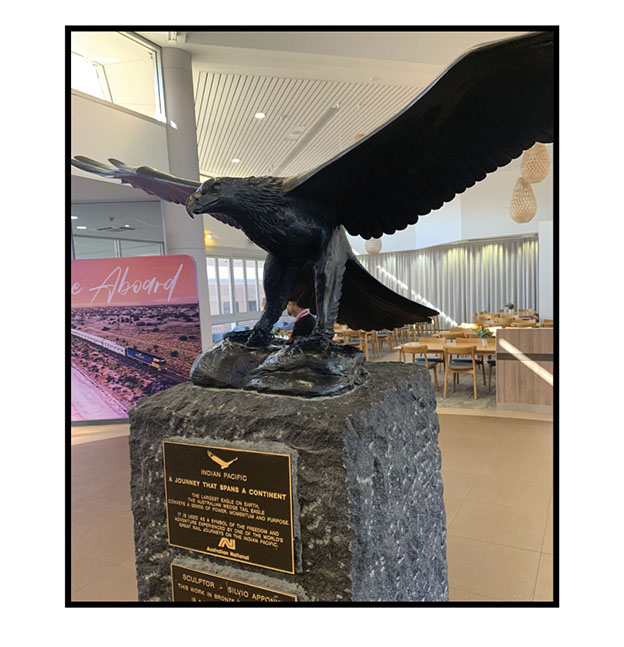
The missus and I caught sight of about 30 camels due to be shipped to the Middle East as racing beasts, and similar small herds of goats. Every now and then a sheep would appear, looking slightly bewildered and cautious of its prospects in life. You can’t blame it; this is truly godless country.
The slight sounds of applause in some carriages were evidence that some lucky buggers had spotted the occasional kangaroo yet to become a withered carcass.
Surely for the amount we’re all paying to tick this world-famous train trip off our bucket lists, the people behind the Indian Pacific could fly some animatronic wedgetail eagles encasing state-of-the-art dronery, flapping their giant wings and swooping down in front of the windows on both sides of the club and dining carriages!
Or how about this? Every now and then, animatronic red kangaroo boomers and old man emus facing off against each other, a coat-of-arms battle to the death, or at least survival in one of the most hostile places on earth!
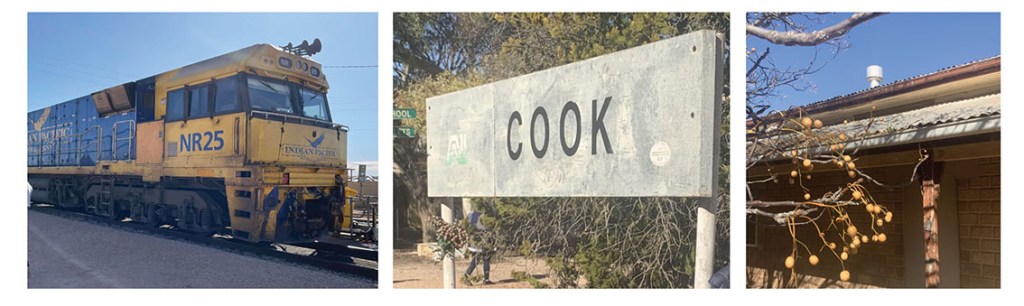
The next stop from the increasing boredom of the Nullarbore is Cook, where a handful of permanent residents – slightly more than the things worth seeing in this almost ghost-town – provide fuel and water to the trains that pass their way.
Still, the passengers pour off the train and cameras, phone or old-fashioned standalone devices, click away merrily, maybe for no other reason than to record things that aren’t saltbush, bluebush or bare sandy soil.
Of interest, to be fair, are the dilapidated men’s and women’s tin lockups where uppity townsfolk in times well past were kept well out of view of travellers passing through.
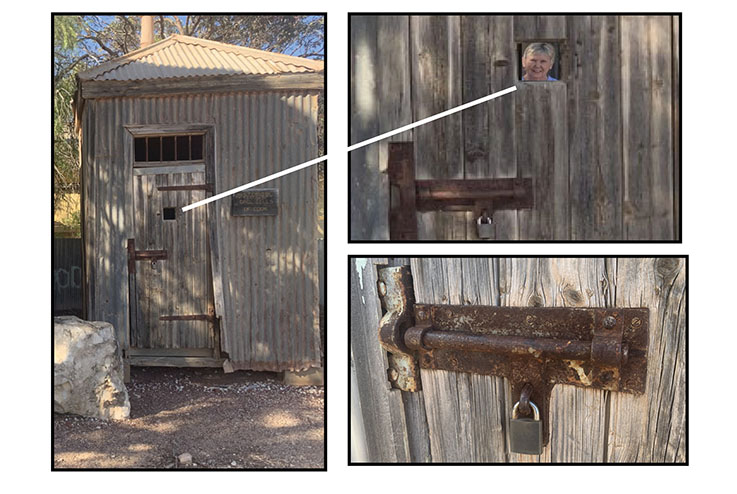
But then it’s back to endless hour after endless hour of that god-forgiven saltbush and bluebush whizzing by.
Passengers caught short of a good book couldn’t be blame if they started to read the dunny paper in their quaint little lavatory/shower nooks.
The reality is that the Nullarbore excited this travel writer only for a little while. The best times were the rare occasions when another line ran beside us to provide some visual variety and, of course, watching with the window blind down to get a totally different perspective (at top).
My guess is that for quite a few on board, a must-see Nullarbore quickly becomes a must-sleep for a few hours before the next excellent meal and top-shelf beer, wine and spirits on offer in the Queen Adelaide restaurant and a couple more lazy drinks in the adjoining outback explorer lounge while keeping an eagle-eyed lookout for that wedge-tail that never appeared.
 The Bug Online