
SCIENCE:
Scientists working in Melbourne on experiments to breed Tasmanian Tigers or thylacines admit they have already made several unsuccessful attempts to clone the native animal that has been extinct since 1936.
The US-based biotechnology firm Colossal Biosciences Inc of Texas is working with Australian geneticists at the University of Melbourne on a $5 million project to use Tasmanian Tiger DNA from a juvenile animal held by Museums Victoria to “rebuild” a thylacine.
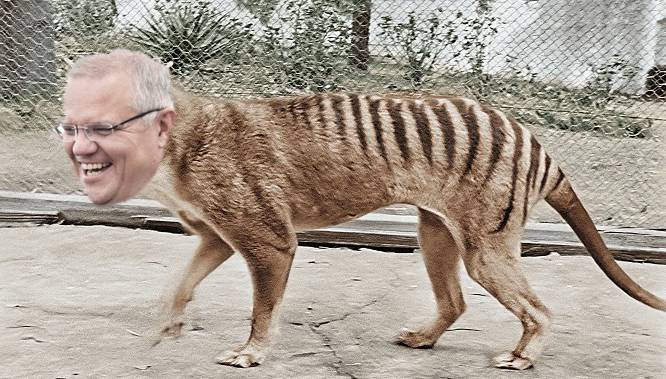
Head of the project, Professor Tess Tyoob of the genetics department at the University of Melbourne, said several rudimentary thylacines had been cloned in laboratory experiments. (main picture)
“We’ve actually bred a couple of Tassie Tigers, but each time we have cloned one it hasn’t turned out to be the animal we thought it was going to be,” Professor Tyoob said.
“There has been no trouble cloning the animal. In fact it seems the thylacine is predisposed to cloning. Some of us in the lab have joked that if left to its own devices it would clone itself.
“But we have been disappointed with the animals we’ve developed so far. None of us in the genetics team can quite yet fathom how and why we have got the unsatisfactory results we’ve observed so far.
“One of the problems with the animals we’ve cloned so far is their level of activity and energy.
“They do very little except bark a lot and lie down. In fact they lie all day long. It seems the only thing the ones we’ve bred so far are good at is lying.
“But we’ll keep on working until we breed out the faulty DNA that we suspect has caused the genetic anomalies that have come to light so far,” she said.
 The Bug Online